3D Exterior Rendering Services for Architects & Developers: The 2026 India Guide
Buying decisions for unbuilt property still happen mostly in the imagination. Architects and developers across India know that a clean 2D plan rarely wins a pre-sale meeting — buyers need to see the facade, the landscape, the evening light on the balcony railing. That’s exactly what 3D exterior rendering services deliver: photoreal visuals that turn blueprints into buyer-ready imagery. In 2026, this service line has matured into a strategic necessity for any developer or design firm selling space before construction. Mordor Intelligence’s latest figures confirm architectural visualization captured 41.9% of the global 3D rendering market last year, with the services segment expanding at a 25.35% CAGR through 2031. This guide walks Indian architects, developers, and builders through pricing, process, software, RERA-compliant deliverables, and a vendor-selection scorecard so you can hire the right studio and budget correctly.
TL;DR / Quick Answer
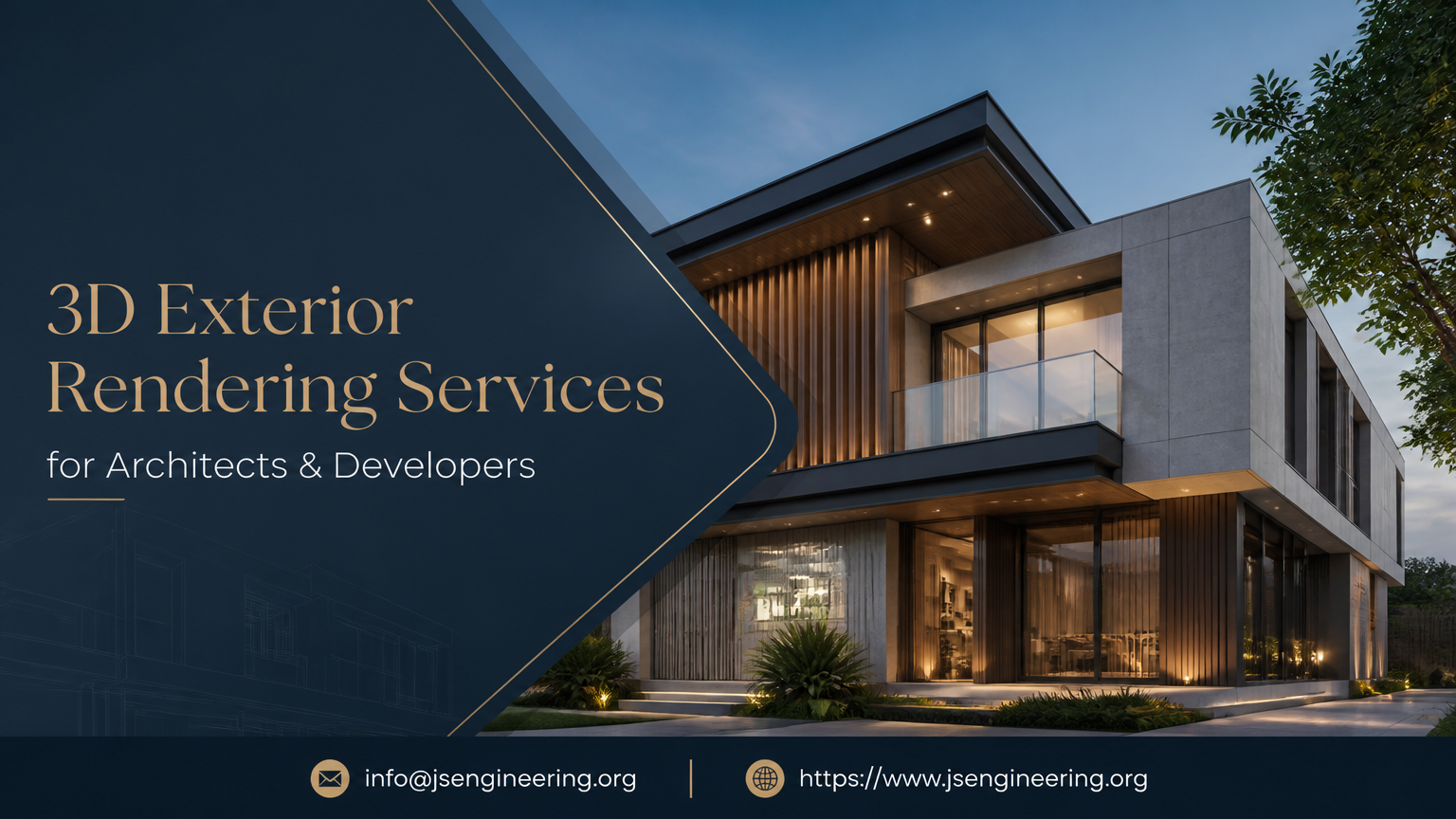
3D exterior rendering services convert architectural plans into photoreal images and animations of building facades, landscapes, and contextual environments before construction. In India in 2026, expect roughly ₹25,000–₹75,000 per static exterior view from tier-2 studios and ₹45,000–₹1,50,000 from tier-1 metros, with walkthrough animation starting around ₹4,500–₹13,000 per second. Use the deliverables, process, and RERA checklist in this guide to evaluate any studio before signing a quote.
Table of Contents
- What Are 3D Exterior Rendering Services?
- Benefits for Indian Real Estate & Architecture
- India Pricing Guide 2026 (INR per view & per second)
- Our 7-Step Production Process
- Software & Technology Stack Used in India
- Key Deliverables: 4K, VR, Vertical Social Cuts, RERA Overlays
- How to Choose the Right 3D Exterior Rendering Vendor in India
- RERA Compliance & Legal Checklist for Indian Projects
- Top 7 Use Cases Across Industries
- Cost Optimisation Tips for Indian Developers
- Frequently Asked Questions
What Are 3D Exterior Rendering Services?
3D exterior rendering services are specialized visualization outputs that transform 2D architectural drawings, CAD files, or BIM models into photorealistic images and animations of building exteriors. These deliverables typically include front and rear elevation renders, multiple angle views, aerial perspectives, landscape integrations, and contextual shots showing the project within its surrounding environment. Studios build them in 3D space using geometry sourced from AutoCAD, Revit, or SketchUp, then layer realistic materials, lighting, sky, vegetation, vehicles, and human figures (called “entourage”) to create imagery that reads like a photograph.
For Indian architects and developers, the practical value is straightforward: a buyer standing in a sales office in Mumbai or Bengaluru can now see exactly how a tower will look at 6 p.m. on a monsoon evening, with the proposed podium garden and the surrounding road context. This service sits inside the broader architectural visualization category, which Mordor Intelligence identifies as the largest single revenue slice of the global 3D rendering market — confirming that exterior visualization is no longer a luxury add-on but a mainstream commercial requirement for serious property marketing in 2026. Studios like JS Engineering Studio describe this category as one of their core offerings under their broader 3D rendering services portfolio.
Benefits for Indian Real Estate & Architecture
The most measurable benefit of professional exterior renders is pre-sale velocity. The National Association of REALTORS’ 2025 Profile of Home Staging found that 17% of buyers’ agents reported offers of 1–5% above asking price after staging, and 30% said properties sold faster on market. A 2025 paper in the Journal of Global Information Management using Beijing housing data reached a parallel conclusion: VR and photoreal visualization meaningfully lifted conversion rates during offline viewings. For Indian developers running pre-launch campaigns in competitive micro-markets like Worli, Bandra, Golf Course Road, or Whitefield, those gains translate directly into faster inventory absorption and stronger price realization.
Beyond sales, exterior renders reduce ambiguity in design approvals. Municipal reviewers, RERA authorities, and society committees evaluate projects faster when they can see realistic massing, facade treatment, and landscape intent rather than reading flat plans. Studios with 14+ years of architectural visualization experience have refined exactly this kind of stakeholder communication for global clients, and their exterior rendering portfolio shows how elevation studies, landscaping integration, and contextual renders consistently support smoother approval conversations across residential and commercial typologies.
India Pricing Guide 2026 (INR per view & per second)
Indian studio pricing in 2026 varies significantly by city tier, project complexity, and delivery speed. As a guideline, here’s how the market typically structures exterior rendering and walkthrough animation quotes:
| Service Type | Tier-2 City Studio (Ahmedabad, Indore, Nagpur) | Tier-1 City Studio (Mumbai, Gurgaon, Bengaluru) |
|---|---|---|
| Static exterior view (standard) | ₹25,000 – ₹40,000 | ₹45,000 – ₹75,000 |
| Static exterior view (high-end / photoreal) | ₹40,000 – ₹70,000 | ₹75,000 – ₹1,50,000 |
| Hero / aerial / twilight angle | ₹60,000 – ₹1,00,000 | ₹1,00,000 – ₹2,00,000 |
| 60-second walkthrough animation | ₹2,50,000 – ₹4,00,000 | ₹4,50,000 – ₹8,00,000 |
| Per-second rate (walkthrough) | ₹4,500 – ₹6,500/sec | ₹7,500 – ₹13,000/sec |
Three drivers move the needle most: photorealism level (standard vs. high-end with custom materials and lighting), revision rounds (most studios include 2–3 before charging extra), and rush delivery (a 30–50% premium is common). Studios like JS Engineering Studio use quote-based pricing with published USD guidelines ($400–$600 per exterior view, $60–$65 per walkthrough second), which international clients often find clearer than opaque INR estimates. Always confirm GST treatment, IP transfer terms, and what is included — sky variations, entourage, custom materials — before signing any quote.
Our 7-Step Production Process
A disciplined 7-step workflow keeps exterior rendering projects on time and on budget, especially when multiple stakeholders are reviewing. Step one is project briefing: the studio collects floor plans, elevations, material references, site context, and brand guidelines. Step two is concept alignment, where camera angles, lighting mood, and time-of-day are locked before modelling begins — saving costly rework once texturing is underway.
Steps three and four cover 3D modelling and texturing. Geometry is built from your CAD, Revit, or SketchUp inputs (or scratch-modelled if drawings are unavailable), then materials, glass reflectivity, stone textures, and metal finishes are applied. Step five is lighting and scene setup: sun angle, ambient light, and atmospherics are tuned to the briefing. Step six is high-resolution rendering, where the studio outputs 4K stills or animation frames. Step seven is post-production — colour grading, sky replacement, vegetation refinement, and overlay of branding, RERA registration numbers, and disclaimers. Studios like JS Engineering Studio’s exterior rendering workflow follow this cadence, with typical turnaround of 3–8 business days per view.
Software & Technology Stack Used in India
Indian studios serious about photoreal exteriors use a layered stack: Autodesk 3ds Max and SketchUp for geometry, Corona Renderer or V-Ray for lighting and materials, AutoCAD and Revit for BIM/CAD input handling, Adobe Photoshop for post-production, and increasingly Unreal Engine for real-time walkthroughs and VR-ready outputs. Twinmotion and Lumion remain popular for faster turnaround on