
Corona Renderer vs AI Rendering for Interiors (2026) – JS Engineering Studio
Interior visualization has changed significantly in recent years. Architects, interior designers, builders, and real estate developers now have more options than ever for turning design concepts into realistic images. Two approaches receiving the most attention in 2026 are Corona Renderer and AI rendering for interiors.
While both can produce impressive visuals, they serve different purposes. Corona Renderer interior rendering focuses on detailed 3D scenes, realistic lighting, materials, cameras, and artistic control. AI rendering, on the other hand, can generate or transform interior concepts quickly, making it useful for early-stage ideas and rapid design exploration.
So, which approach is better? The answer depends on the project, required accuracy, deadline, and desired level of control.
Corona Renderer for Interior Visualization
Corona Renderer has become a popular solution for professional architectural visualization, particularly for high-quality interior scenes. It works with detailed 3D models and allows artists to control lighting, materials, textures, reflections, shadows, cameras, and composition.
For Professional interior visualization, this level of control is important. A designer can specify the exact flooring, cabinetry, wall finishes, furniture, lighting fixtures, fabrics, and decorative elements required for the project.
Corona Renderer interior rendering is especially useful when the final image needs to closely represent an actual design proposal. Instead of generating an approximate interpretation, the visualization artist can build the scene around the project’s specifications.
For commercial interiors, luxury residences, hospitality projects, and real estate marketing, this precision can make a significant difference.
What Is AI Rendering for Interiors?
AI Rendering for Interiors uses artificial intelligence to create, enhance, or transform interior visuals from prompts, sketches, photographs, or existing 3D imagery.
One of its biggest advantages is speed. Designers can explore different furniture arrangements, color palettes, architectural styles, and decorative concepts without rebuilding an entire 3D scene for every variation.
AI Interior Rendering can therefore be valuable during the concept-development stage.
For example, an architect may have a basic floor plan or SketchUp model and want to quickly explore several interior directions. AI can help generate visual references that communicate those ideas to a client before investing significant time in detailed production.
However, AI-generated imagery can sometimes change dimensions, architectural elements, materials, or other project-specific details. For projects where accuracy is critical, these limitations need to be considered.
Corona Renderer vs AI Rendering: Key Differences
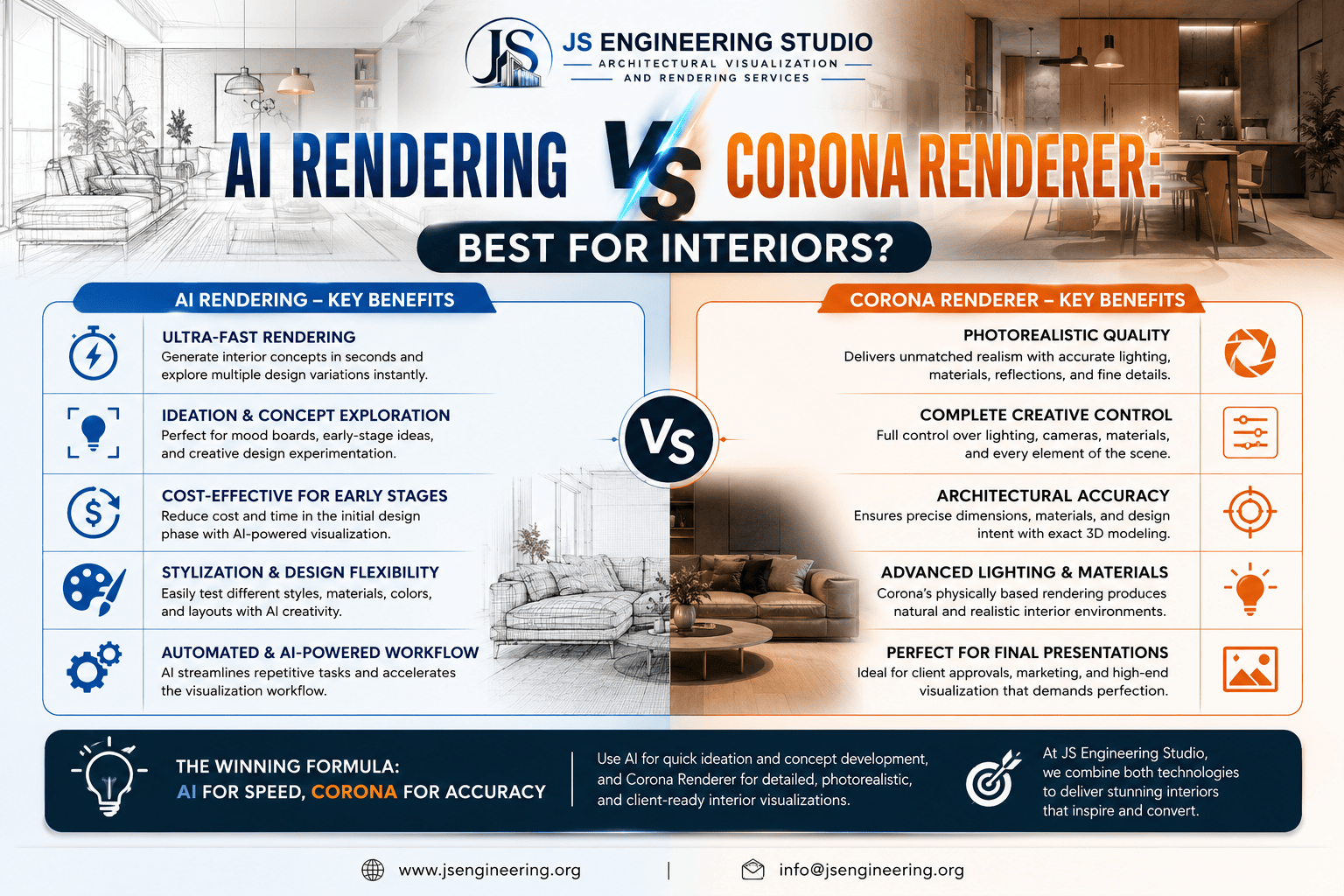
The main difference between Corona Renderer vs AI Rendering is the level of control and predictability.
Corona provides a structured 3D workflow. The artist controls the geometry, materials, lighting, camera, furniture placement, and environment. This makes it easier to maintain consistency across multiple views.
AI rendering is generally faster for experimentation. It can produce multiple concepts quickly, but the result may not always follow precise architectural instructions.
For professional AI Architectural Rendering, AI can be extremely useful for brainstorming and visualization studies. However, a detailed 3D rendering workflow remains valuable when the client expects the final image to accurately represent the proposed design.
Key comparison:
| Factor | Corona Renderer | AI Rendering |
|---|---|---|
| Photorealism | Excellent | Very good |
| Design control | Very high | Moderate |
| Speed | Moderate | Very fast |
| Material accuracy | Excellent | Variable |
| Architectural accuracy | Excellent with correct model | Can vary |
| Design exploration | Good | Excellent |
| Client presentations | Excellent | Good for concepts |
| Multiple concept variations | Slower | Very fast |
| Final marketing renders | Excellent | Project-dependent |
AI Rendering vs Corona Renderer for Photorealism
When comparing AI Rendering vs Corona Renderer for Photorealism, the quality gap is becoming smaller, but the production process remains different.
Corona is designed around physically based rendering and detailed scene construction. This allows an artist to carefully manage light sources, reflections, glass, fabrics, wood, metals, stone, and other materials.
AI can produce highly convincing images, particularly when the goal is to create an attractive design concept. However, visual realism does not always mean architectural accuracy.
For a real estate developer marketing a specific apartment, for example, the kitchen layout, window position, flooring, cabinetry, and furniture dimensions may need to remain consistent. In such situations, controlled photorealistic interior rendering can be more dependable.
Rendering Speed and Workflow
Speed is where AI has a major advantage.
Traditional 3D Interior Rendering requires modeling, texturing, lighting, camera setup, rendering, post-production, and revisions. A professional artist can produce excellent results, but the process takes time.
AI Rendering for Interiors can generate initial concepts within minutes. This makes it useful for mood boards, design directions, early client discussions, and alternative concepts.
However, fast generation does not necessarily eliminate the need for professional visualization. AI outputs may require correction, compositing, modeling, or additional rendering before they are suitable for final commercial use.
Material and Lighting Accuracy
Material and lighting accuracy are critical in professional interior visualization.
Corona gives artists direct control over materials and lighting. This is particularly important when a project depends on accurate representation of marble, wood, glass, metal, fabrics, polished surfaces, or architectural lighting.
AI can imitate these characteristics convincingly, but it may interpret materials rather than reproduce their exact physical properties.
For clients selecting actual materials or reviewing a proposed interior design, Corona Interior Rendering can therefore provide a more controlled representation.
Which Is Better for Interior Designers and Architects?
There is no universal winner between Corona Renderer and AI rendering.
Interior designers may prefer AI for quickly exploring different styles and presenting early concepts. Architects can use AI Rendering for Architecture to investigate design directions and communicate ideas during the initial stages.
For final client presentations, sales imagery, and detailed design visualization, professional 3D production can offer greater consistency.
At JS Engineering Studio, the right workflow should be determined by the project’s objective rather than simply choosing the newest technology. A concept image, design-development image, and final marketing image may each require a different approach.
Can AI Replace Corona Renderer in 2026?
The question of whether AI can replace Corona Renderer is becoming increasingly common.
AI is certainly changing the architectural visualization workflow, but complete replacement is not necessarily the best way to view the technology.
AI is excellent for generating ideas, testing styles, creating variations, and accelerating repetitive visualization tasks. Corona remains valuable for projects requiring detailed geometry, controlled materials, accurate lighting, and consistent camera views.
For professional AI Rendering for Architecture, the strongest workflow may therefore combine AI capabilities with established 3D rendering techniques.
Why a Hybrid AI + Corona Workflow Makes Sense
A hybrid workflow combines the strengths of both technologies.
An architect or interior designer could use AI to explore several concepts at the beginning of a project. Once the preferred direction is selected, a detailed 3D model can be developed and rendered using Corona.
AI can also assist with references, mood exploration, image enhancement, and creative variations, while Corona can provide the controlled final visualization.
This approach can help studios improve efficiency without sacrificing the accuracy expected from professional Interior Visualization.
For JS Engineering Studio, this type of workflow can be particularly useful for architects, builders, developers, and interior designers who need both creative flexibility and professional-quality final imagery.
Final Verdict: Corona Renderer vs AI Rendering
The Corona Renderer vs AI Rendering debate is less about choosing one technology and more about understanding where each performs best.
AI Rendering for Interiors is excellent for speed, concept development, experimentation, and rapid visual exploration. Corona Renderer remains a strong choice for detailed, controlled, and photorealistic interior visualization.
In 2026, the most practical approach may be to use both technologies strategically. AI can accelerate the creative process, while Corona can deliver the precision and consistency required for professional architectural visualization.
For projects where design accuracy, realistic materials, lighting, and client confidence matter, a professional 3D rendering workflow remains an important part of the process.
JS Engineering Studio combines architectural visualization expertise with modern rendering workflows to help architects, designers, builders, and real estate professionals communicate their ideas through high-quality 3D imagery. Contact us! Get in touch email us at info@jsengineering.org.
Frequently Asked Questions:
Is Corona Renderer better than AI rendering for interiors?
Corona Renderer is generally better when precise geometry, materials, lighting, and consistent architectural details are required. AI rendering can be better for rapid concept development and design exploration.
Is AI rendering faster than Corona Renderer?
Yes. AI can generate initial visual concepts much faster than a traditional 3D rendering workflow. However, additional work may be required if the image needs architectural accuracy.
Can AI replace 3D interior rendering?
AI can support and accelerate 3D Interior Rendering, but it does not eliminate the need for detailed 3D production in every project. Accuracy and consistency remain important for professional visualization.
What is better for photorealistic interior rendering?
Both technologies can produce highly realistic images. Corona offers greater control over geometry, materials, lighting, and camera settings, making it well suited to professional photorealistic interior rendering.
Should architects use AI rendering or Corona Renderer?
Architects can benefit from both. AI is useful for quickly exploring ideas, while Corona can be used when a project requires detailed and controlled final visualization.
What is the best AI rendering workflow for interiors?
A practical workflow is to use AI during concept development and then use detailed 3D modeling and Corona rendering for final images when accuracy and consistency are important.
Can JS Engineering Studio provide AI and traditional rendering solutions?
JS Engineering Studio can help professionals choose an appropriate architectural visualization workflow based on the project’s design requirements, presentation goals, and level of detail needed.