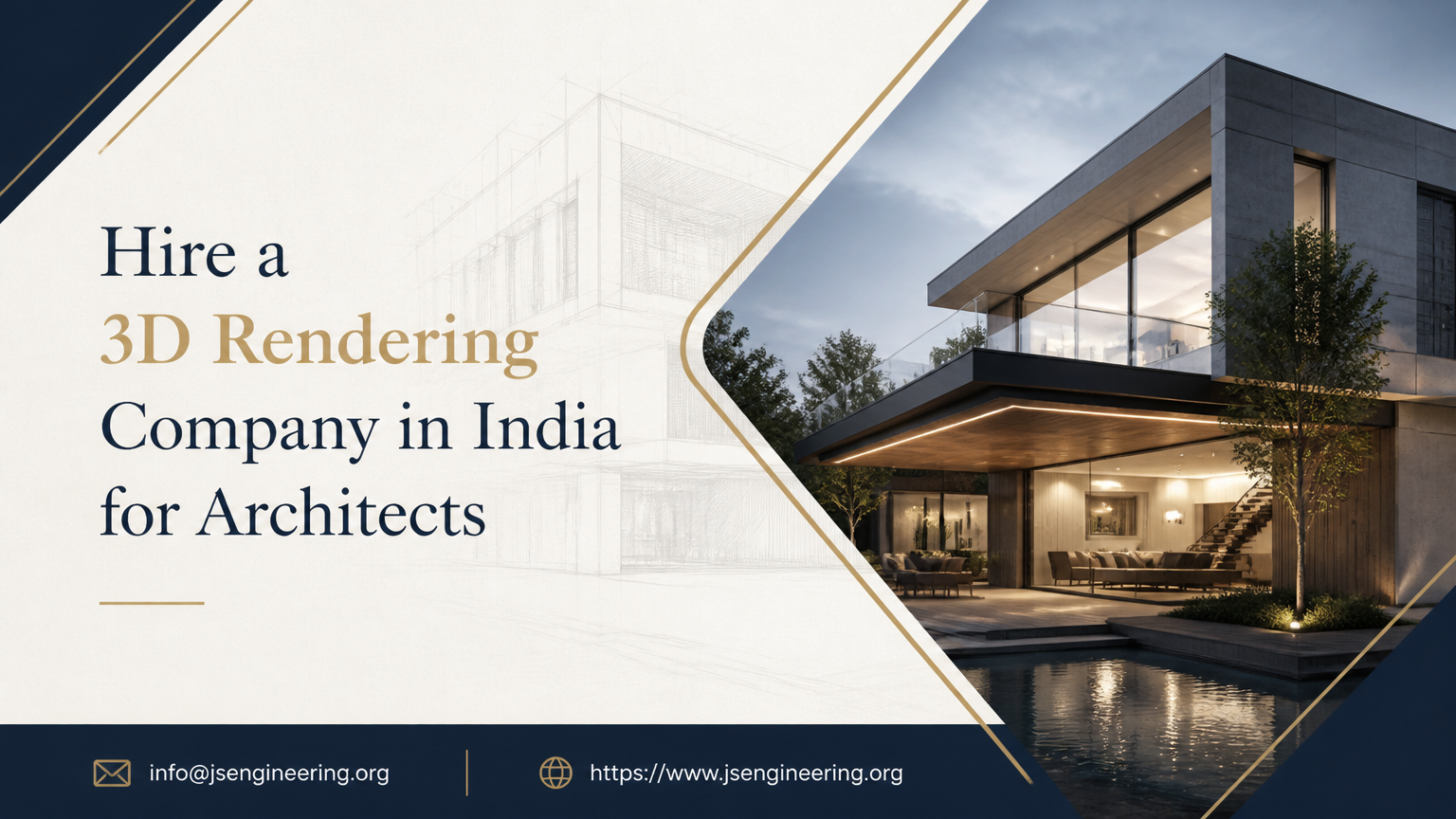
Hire a 3D Rendering Company in India for Architects
The Complete 2026 Buyer’s Guide
Choosing to hire a 3D rendering company in India can save architects thousands of dollars per project while unlocking photorealistic visuals that win client approvals faster. But the decision carries real risk—picking the wrong vendor means missed deadlines, revision headaches, and renders that misrepresent your design intent
India’s 3D rendering market reached approximately USD 171.1 million in 2024 and is forecast to hit USD 1,025.8 million by 2033 at a 22.5% CAGR, according to 6Wresearch. That explosive growth means more studios, more choices—and more noise to filter through
This guide walks you through services, pricing, vetting checklists, red flags, and the exact step-by-step process for outsourcing architectural rendering to Indian studios so you can make a confident, informed hiring decision
TL;DR / Quick Answer
To hire a 3D rendering company in India, shortlist studios with 5+ years of experience, verified architectural portfolios, transparent per-view pricing, and clear revision policies. Typical costs range from USD $350–$600 per still image and $60–$65 per second of walkthrough animation. Vet candidates through portfolio depth, client references, technology stack, and contract clarity before committing
Table of Contents
- Why Hire a 3D Rendering Company in India
- Top 3D Rendering Services You Can Outsource to India
- Cost of Hiring a 3D Rendering Company in India (2026 Pricing
- Step-by-Step Process to Hire a 3D Rendering Company in India
- Vetting Checklist: Portfolio, Revisions, Tech Stack and References
- Red Flags, Contracts, NDAs and IP Protection
- Sample Client Case Studies and Outcomes
- Expert Insights—What to Look for in 2026
- FAQs on Hiring 3D Rendering Companies in India
Why Hire a 3D Rendering Company in India? Cost, Talent and Time-Zone Advantage
India has become the global hub for outsourced architectural visualization. The primary draw is cost efficiency—architects in the US, UK, and Australia routinely save 40–60% compared to local rendering studios without sacrificing photorealism. But cost is only part of the equation. India produces tens of thousands of architecture graduates annually through institutions accredited by the Council of Architecture, creating a deep talent pool fluent in tools like 3ds Max, V-Ray, Corona Renderer, and Unreal Engine. The domestic architectural services market is itself booming: Mordor Intelligence values it at USD 14.22 billion in 2025, projected to reach USD 23.30 billion by 2031 at an 8.66% CAGR. India’s BIM market is growing even faster—MarketsandMarkets projects it will expand from USD 383.2 million in 2025 to USD 1,041.7 million by 2030 at a 22.1% CAGR, nearly double the global rate
The time-zone difference works directly in architects’ favor. Submit a project brief in the evening and wake up to draft renders the next morning—a natural overnight production cycle that compresses delivery timelines. Established studios like JS Engineering Studio, with over 14 years of experience serving architects across the USA, Canada, UK, and Australia, have built workflows specifically around this advantage. Studios serving global markets also understand international building codes, material palettes, and presentation standards. When you hire a 3D rendering company in India, you’re tapping into an ecosystem that is structurally invested in faster pipelines, deeper BIM integration, and more sophisticated deliverables than ever before
Top 3D Rendering Services You Can Outsource to India
Indian rendering studios offer a comprehensive service menu covering every stage of architectural visualization. 3D interior rendering produces photorealistic room visuals—living rooms, kitchens, bathrooms, lobbies—complete with accurate lighting, materials, and furniture arrangement. 3D exterior rendering covers front and rear elevations, aerial perspectives, and landscape-integrated views that show buildings in environmental context. Floor plan rendering comes in both 2D (clean, annotated layouts) and 3D (texture-rich, perspective views) formats that help clients understand spatial flow before construction begins. According to Dataintelo, architects are the single largest end-user category of 3D rendering services worldwide, commanding a 29.7% market share in 2025—confirming that these services are core to architectural practice
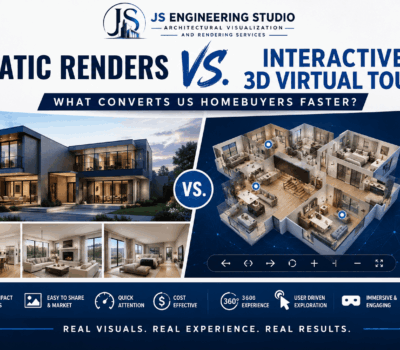
Beyond still images, studios provide 3D animation walkthroughs—immersive fly-through videos that let stakeholders virtually navigate unbuilt spaces. A full range of 3D rendering services typically includes product rendering and product animation as well, serving designers and manufacturers who need marketing visuals without physical prototypes. When evaluating a studio’s service range, match their capabilities to your project type. Residential architects need strong interior and exterior rendering. Commercial developers benefit from walkthrough animations for investor presentations. The best Indian studios handle all of these under one roof, eliminating the coordination overhead of managing multiple vendors
Cost of Hiring a 3D Rendering Company in India (2026 Pricing Ranges
Indian rendering studios typically price per view, per second (for animations), or per project package. Guideline ranges for 2026 are approximately: exterior 3D rendering at USD $400–$600 per view, interior 3D rendering at USD $350–$550 per room, luxury or high-end rendering from $700+ per image, and 3D walkthrough animation from $60–$65 per second. These are guideline figures—final pricing depends on project complexity, number of views, photorealism level, whether the studio is modeling from scratch or using existing CAD/Revit files, custom materials, entourage, and turnaround urgency. Package pricing for full project sets (multiple interior and exterior views) can offer meaningful savings over per-view pricing. Always request a detailed, itemized quote to understand exactly what’s included
Several factors push costs higher: custom furniture modeling, complex landscaping, night scenes with artificial lighting, and rush delivery. To control your budget, provide clean CAD or SketchUp source files, consolidate revision rounds into structured feedback, and define scope clearly before work begins. Studios that price per square foot rather than per view may seem attractive but often produce inconsistent results because rendering complexity depends far more on detail level than building size. If you want to request a custom quote for your rendering project, most established Indian studios respond within 24 hours with a tailored estimate based on your brief, source files, and deadline requirements
Step-by-Step Process to Hire a 3D Rendering Company in India
Start with a clear project brief. Define the number of views, resolution, style references (photorealistic vs. stylized), target audience, and deadline. Include CAD drawings, SketchUp models, or Revit files—cleaner inputs produce faster, more accurate outputs. Next, research potential studios. Search for companies with architectural portfolios that match your project type. Shortlist 3–5 firms and review their work for photorealism quality, lighting accuracy, material realism, and attention to architectural detail. Check Google reviews, Clutch profiles, and client testimonials for reliability signals. Then, request proposals. Send your brief to each shortlisted studio and compare quotes on scope, revision policy, turnaround, and deliverable format—not just price
Before committing, ask for a paid test render on a single view. This small investment (typically $200–$400) reveals the studio’s actual quality, communication speed, and revision responsiveness far better than any portfolio review. Once satisfied, negotiate a contract specifying deliverables, revision rounds, payment milestones, NDA terms, and IP ownership. During production, maintain structured feedback—consolidate all comments into a single document per revision round rather than sending piecemeal emails. For deeper guidance on building your vendor evaluation framework, explore insights and resources on hiring 3D rendering companies. The process from initial brief to final delivery typically spans 2–4 weeks for a standard residential project set of 5–8 views
Vetting Checklist: Portfolio, Revisions, Tech Stack and References
A strong portfolio is your most reliable vetting tool. Look for consistency across multiple projects—not just cherry-picked hero images. Examine lighting quality in both daytime and evening renders, check that materials look physically accurate (wood grain, stone texture, fabric drape), and verify that architectural elements like glazing, railings, and joinery are modeled with precision. When reviewing completed rendering projects, notice how interior lighting, material finishes, and spatial depth are handled across different project types. Revision policies reveal a studio’s professionalism. The best firms offer 2–3 structured revision rounds included in the base price, with clear definitions of what constitutes a revision versus a scope change. Avoid studios that charge for every minor adjustment
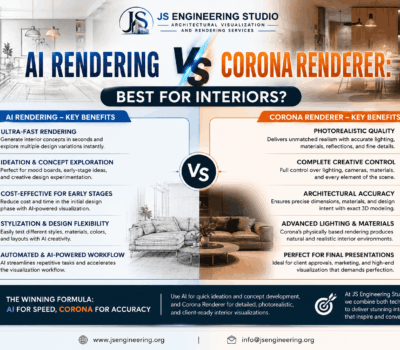
Technology stack matters. Studios using 3ds Max with V-Ray or Corona Renderer produce the highest photorealism for static images. For interactive deliverables, Unreal Engine is increasingly standard. Ask whether the studio can accept your native file format (Revit, SketchUp, AutoCAD) or if conversion fees apply. References are non-negotiable—request 2–3 direct client contacts and ask specifically about communication responsiveness, deadline adherence, and whether final deliverables matched the approved brief. Build a weighted scoring rubric: assign 30% to portfolio quality, 25% to pricing transparency, 20% to revision policy, 15% to technology capability, and 10% to client references. This systematic approach removes gut-feel bias from your decision
Red Flags, Contracts, NDAs and IP Protection When Hiring Indian Studios
Certain warning signs should give you pause. Unusually low quotes—say, $100 per photorealistic exterior view—typically mean the studio is cutting corners on modeling detail, using generic stock assets, or planning to outsource your work to unvetted freelancers. Inconsistent portfolios where some images look professional and others look amateurish suggest the studio may be showcasing work it didn’t actually produce. Other red flags include no written contract, refusal to sign an NDA, vague revision policies, no physical business address, and communication delays exceeding 48 business hours during the proposal stage. If a studio can’t respond promptly when trying to win your business, delivery-stage communication will be worse
Your contract should specify deliverable format (TIFF, JPEG, resolution), number of revision rounds, milestone payment schedule (typically 30–50% upfront, balance on delivery), and late-delivery penalties. An NDA protects your design IP and prevents the studio from using your project images in their portfolio without consent—though most studios will request portfolio rights as a standard clause, which you can negotiate. IP ownership is critical: ensure the contract states that all final renders and source files transfer to you upon full payment. If you need to contact an experienced architectural visualization team to discuss contract terms and project confidentiality, established studios are accustomed to international NDA and IP frameworks
Sample Client Case Studies and Outcomes
When architects hire the right 3D rendering company in India, the results speak for themselves. A typical residential project—say, a 5-view set covering front elevation, rear elevation, living room, kitchen, and master bedroom—can be completed in 10–15 business days at a fraction of US or UK studio rates. The visuals then serve triple duty: client presentations, planning authority submissions, and marketing materials for pre-construction sales. Client feedback consistently highlights three outcomes: faster design approvals because stakeholders respond more decisively to photorealistic images than line drawings, reduced change orders as clients identify design issues visually before construction, and stronger marketing collateral for brochures, websites, and social media
Consider a developer presenting a 20-unit luxury residential project to investors. Instead of floor plans and mood boards, a set of photorealistic interior and exterior renders plus a 60-second walkthrough animation conveys the vision instantly. Studios with experience across residential, commercial, hospitality, and mixed-use projects understand these presentation contexts—they design renders not just for accuracy but for emotional impact. To see real examples across project types and scales, browse a studio’s portfolio to evaluate how architectural visualization translates design intent into compelling visuals. The key is finding a studio whose work shows consistent quality across the specific project type you’re commissioning
Expert Insights—What to Look for in 2026
The 3D rendering landscape is shifting fast. AI-assisted denoising and upscaling are reducing render times by 30–50% without sacrificing quality, meaning studios can deliver faster at lower cost. Real-time rendering engines like Unreal Engine 5 are enabling interactive walkthroughs that were prohibitively expensive just two years ago. When evaluating Indian studios in 2026, ask specifically about their AI and real-time capabilities—these aren’t future trends; they’re current differentiators. BIM-to-render workflows are another critical capability. With India’s BIM market growing at a 22.1% CAGR, studios that can import Revit models directly and maintain parametric data through the rendering pipeline deliver more accurate outputs with fewer revisions
Data security practices are also rising in importance. With global architecture firms sharing proprietary designs, ask potential studios about their data-handling protocols: secure file transfer, restricted project access, and post-delivery file deletion policies. The bottom line for 2026: don’t just compare portfolios and prices. Evaluate studios on their technology roadmap, BIM fluency, AI integration, and data-security posture. These factors determine whether your rendering partner can keep pace with your firm’s evolving needs over the next 3–5 years, not just your current project. For further reading on evaluation frameworks and industry trends, review frequently asked questions about 3D rendering services to deepen your understanding before shortlisting vendors
Conclusion
Hiring a 3D rendering company in India gives architects access to world-class photorealistic visualization at competitive pricing—but only if you vet systematically. Start with a clear brief, shortlist studios with verified architectural portfolios, compare on scope and revision policy rather than price alone, and protect your interests with a solid contract and NDA. India’s rendering industry is scaling rapidly, with deeper BIM integration and faster pipelines than ever. Take the time to evaluate your options carefully, and the right partner will transform how you present, sell, and approve architectural designs. Ready to get started? Get a tailored quote from our team and see how outsourced rendering fits your next project
FAQs on Hiring 3D Rendering Companies in India
What is a 3D rendering company in India
A 3D rendering company in India creates photorealistic digital visualizations of architectural designs, interiors, exteriors, and products using software like 3ds Max, V-Ray, and Unreal Engine. Indian studios serve global architects and developers at competitive pricing
How much does it cost to hire a 3D rendering company in India
Typical 2026 guideline rates range from USD $350–$550 per interior view, $400–$600 per exterior view, and $60–$65 per second of walkthrough animation. Final pricing depends on project complexity, photorealism level, and turnaround requirements
How long does 3D rendering take from an Indian studio
Standard turnaround is 3–5 business days per interior view, 3–8 business days per exterior view, and 5–10 business days for multi-view project sets. Rush delivery is available for selected projects based on scope
What should I look for when choosing a 3D rendering company in India
Evaluate portfolio consistency, revision policy, technology stack, client references, contract transparency, and NDA/IP terms. A paid test render on a single view is the most reliable quality check before committing to a full project
Do Indian 3D rendering companies sign NDAs
Reputable Indian studios routinely sign NDAs and agree to IP ownership terms. Verify this during the proposal stage—any studio that refuses to discuss confidentiality terms is a red flag
Can Indian studios handle BIM-based rendering workflows
Yes. Many established Indian studios work directly with Revit and SketchUp models. India’s BIM market is growing at 22.1% CAGR, and studios increasingly offer BIM-to-render pipelines that preserve design accuracy and reduce revision cycles