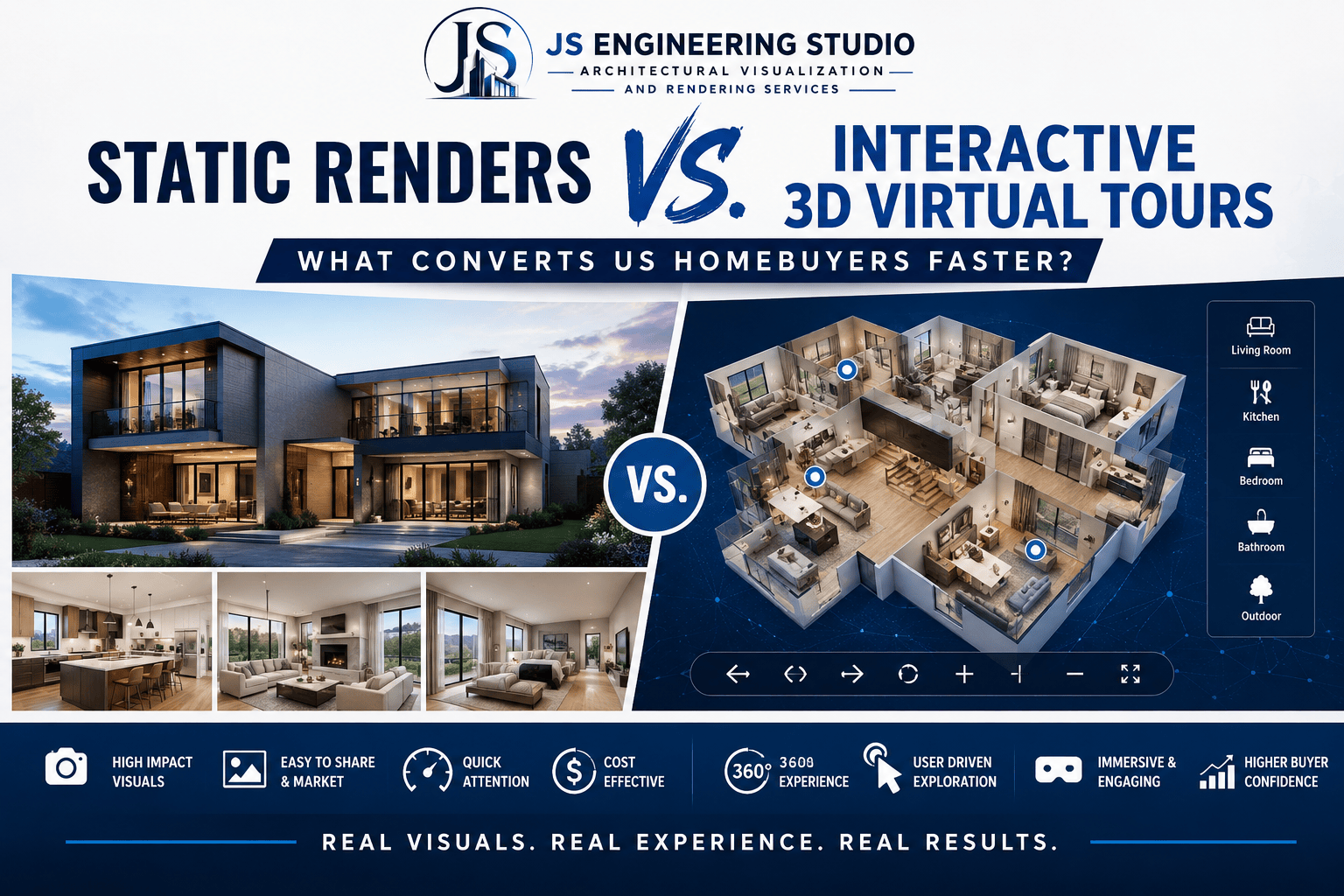
Static Renders vs. Interactive 3D Virtual Tours: What Converts US Homebuyers Faster? – JS Engineering Studio
Buying a home is a major decision, and today’s US homebuyers expect more than floor plans and basic property photographs. They want to understand how a property looks, feels, and functions before scheduling a visit. This is where Static Architectural Renders and Interactive 3D Virtual Tours have become powerful tools for real estate marketing.
Both approaches help buyers visualize properties that are under construction, newly designed, or not yet available for photography. But which one creates stronger engagement and helps convert interested prospects faster?
Interactive 3D virtual tours facilitate a significantly quicker conversion of US homebuyers compared to static renders. Listings that include Interactive 3D Walkthroughs can sell up to 31% faster, attract 40% to 80% more inquiries, and maintain buyer engagement for 52% longer than static images or conventional photo galleries.
The answer depends on the project, target audience, and stage of the sales process. In many cases, combining 3D Rendering for Real Estate with interactive experiences delivers the strongest marketing impact.
What Are Static Architectural Renders?
Static Architectural Renders are high-quality 3D images created to show a property’s exterior, interior, landscaping, amenities, and surrounding environment.
Instead of waiting for construction to finish, developers can use photorealistic CGI to present the finished vision to potential buyers.
For example, a residential developer can showcase:
- Exterior elevations
- Living rooms and kitchens
- Bedrooms and bathrooms
- Pools and outdoor spaces
- Landscaping
- Community amenities
- Streetscapes and neighborhood environments
Static Renders for Real Estate are particularly useful for websites, brochures, social media campaigns, property listings, advertisements, and sales presentations.
A well-produced image can communicate the architectural style and emotional appeal of a property within seconds.
What Are Interactive 3D Virtual Tours?
Interactive 3D Virtual Tours allow potential buyers to explore a property digitally rather than simply viewing individual images.
Users can navigate through rooms, change viewpoints, inspect spaces, and understand the relationship between different areas of the property.
This makes 3D Virtual Tours for Homebuyers especially useful for properties that are still under development.
A buyer in California, for example, could explore a new home development in Texas without physically traveling to the site.
Interactive experiences can help buyers understand:
- Room layouts
- Spatial relationships
- Interior flow
- Property size and proportions
- Interior finishes
- Views from different locations
- Outdoor connections
- Overall living experience
This level of engagement makes Real Estate 3D Virtual Tours more immersive than traditional property images.
3D Virtual Tour vs Static Images: Which Performs Better?
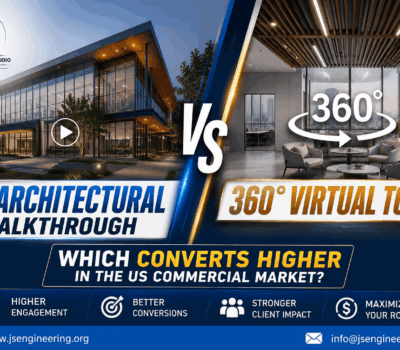
When comparing 3D Virtual Tour vs Static Images, neither format should automatically be considered the winner.
Static images are faster to consume. A buyer can scroll through several renders on a website, social media platform, or digital advertisement within seconds.
Virtual tours require more interaction but provide significantly more control over how buyers explore the property.
The difference can be summarized simply:
Static renders attract attention. Interactive tours encourage exploration.
For initial advertising, Static Renders for Real Estate can be extremely effective because they immediately communicate the property’s visual identity.
For serious prospects who want more information, an interactive experience can help them understand the property in greater depth.
Why 3D Virtual Tours Can Improve Buyer Engagement
One of the biggest advantages of Interactive 3D Tours for Real Estate is the ability to put buyers in control.
Instead of showing only the camera angles selected by the marketing team, an interactive tour lets users explore the property according to their own interests.
Someone interested in the kitchen can spend more time there. Another buyer may want to examine the master bedroom, backyard, or connection between indoor and outdoor areas.
This personalized experience can make the property easier to understand and remember.
For developers selling homes before construction is complete, Homebuyer Property Visualization can also reduce uncertainty. Buyers can get a better idea of what they are purchasing before the physical property exists.
Where Static Renders Still Have a Major Advantage
Despite the popularity of virtual experiences, static CGI remains an essential part of Real Estate Marketing Visualization.
A professionally composed render can be used almost anywhere:
- Google and website campaigns
- Instagram and Facebook
- Digital brochures
- Billboards
- Property listing platforms
- Email campaigns
- Sales presentations
- Print advertising
Static images are also easier to share. A compelling exterior rendering can communicate the property’s key selling points immediately without requiring the viewer to interact with a digital environment.
This is why Real Estate Visualization strategies should not focus exclusively on one format.
The Best Strategy: Combine Both
For many US residential developments, the most effective solution is a combination of static imagery and interactive experiences.
A developer might use a hero exterior render on the website to capture attention, followed by interior images showing the lifestyle and finishes. A 3D Virtual Tour for Homebuyers can then provide an immersive way for serious prospects to explore the complete property.
This creates a logical marketing journey:
Attract → Inform → Engage → Convert
Static imagery creates the first impression, while interactive visualization provides additional confidence before a buyer contacts the sales team.
The Role of Architectural Visualization for Homebuyers
Modern Architectural Visualization for Homebuyers is no longer simply about making a building look attractive. It is about helping potential buyers understand the lifestyle, experience, and value associated with a property.
Photorealistic materials, realistic lighting, landscaping, furniture, people, vehicles, and environmental details can make a proposed development feel tangible.
For developers, this can be particularly valuable when marketing properties before construction.
Instead of asking buyers to imagine the finished project from technical drawings, 3D Rendering for Real Estate gives them something much easier to understand.
What Should US Developers Choose?
The right choice depends on the project.
Choose static renders when:
- You need strong advertising visuals.
- The project requires brochures or sales presentations.
- You want social media-ready content.
- You need multiple exterior or interior views.
- Buyers need quick visual information.
Choose interactive virtual tours when:
- You want deeper buyer engagement.
- The property has complex layouts.
- You are marketing pre-construction homes.
- Buyers are located outside the local market.
- You want prospects to explore the property independently.
For larger developments, using both formats can provide a more complete sales experience.
How JS Engineering Studio Helps Real Estate Professionals
At JS Engineering Studio, we create architectural visualization solutions designed to help architects, builders, developers, and real estate professionals communicate their projects more effectively.
Our services include photorealistic interior and exterior rendering, real estate visualization, architectural CGI, and 3D walkthrough solutions.
The goal is simple: transform architectural concepts into visual experiences that potential buyers can understand and connect with.
For US real estate marketing, the combination of compelling static imagery and immersive visualization can help projects stand out in an increasingly competitive market.
Final Verdict: Which Converts US Homebuyers Faster?
So, Static Renders vs. Interactive 3D Virtual Tours—which converts faster?
There is no single answer for every property. Static renders are excellent for grabbing attention and communicating a project’s visual appeal quickly. Interactive tours are stronger when buyers need to explore, understand, and experience a property before making a decision.
For many developers, the smartest approach is not choosing one over the other.
Use static renders to attract buyers and interactive 3D experiences to move serious prospects closer to a decision.
That combination creates a stronger Real Estate Marketing Visualization strategy and gives US homebuyers the information and confidence they need before taking the next step. For projects where design accuracy, realistic materials, lighting, and client confidence matter, a professional 3D rendering workflow remains an important part of the process. Contact us! Get in touch email us at info@jsengineering.org.
Frequently Asked Questions:
1. Are 3D Virtual Tours better than static renders for real estate?
Not necessarily. Static renders are excellent for advertising and quick visual communication, while virtual tours provide deeper interaction. Using both can create a more effective marketing strategy.
2. How do 3D Virtual Tours help homebuyers?
3D Virtual Tours for Homebuyers allow potential buyers to explore rooms, layouts, finishes, and property features digitally before visiting the physical property.
3. Are Static Architectural Renders useful for pre-construction properties?
Yes. Static Architectural Renders can show buyers what a proposed home or development is expected to look like before construction is completed.
4. Can virtual tours be used for new developments?
Absolutely. Interactive 3D Tours for Real Estate are especially valuable for new developments because buyers can explore spaces that may not physically exist yet.
5. Should developers use both static renders and virtual tours?
For many projects, yes. Static imagery is ideal for attracting attention across marketing channels, while interactive tours can provide a deeper experience for highly interested prospects.
6. Who provides 3D rendering and visualization services?
JS Engineering Studio provides professional architectural visualization, photorealistic 3D rendering, real estate visualization, and 3D walkthrough solutions for architects, builders, developers, and real estate professionals.