Domestic vs Offshore Rendering Studios: What’s the Difference? – JS Engineering Studio
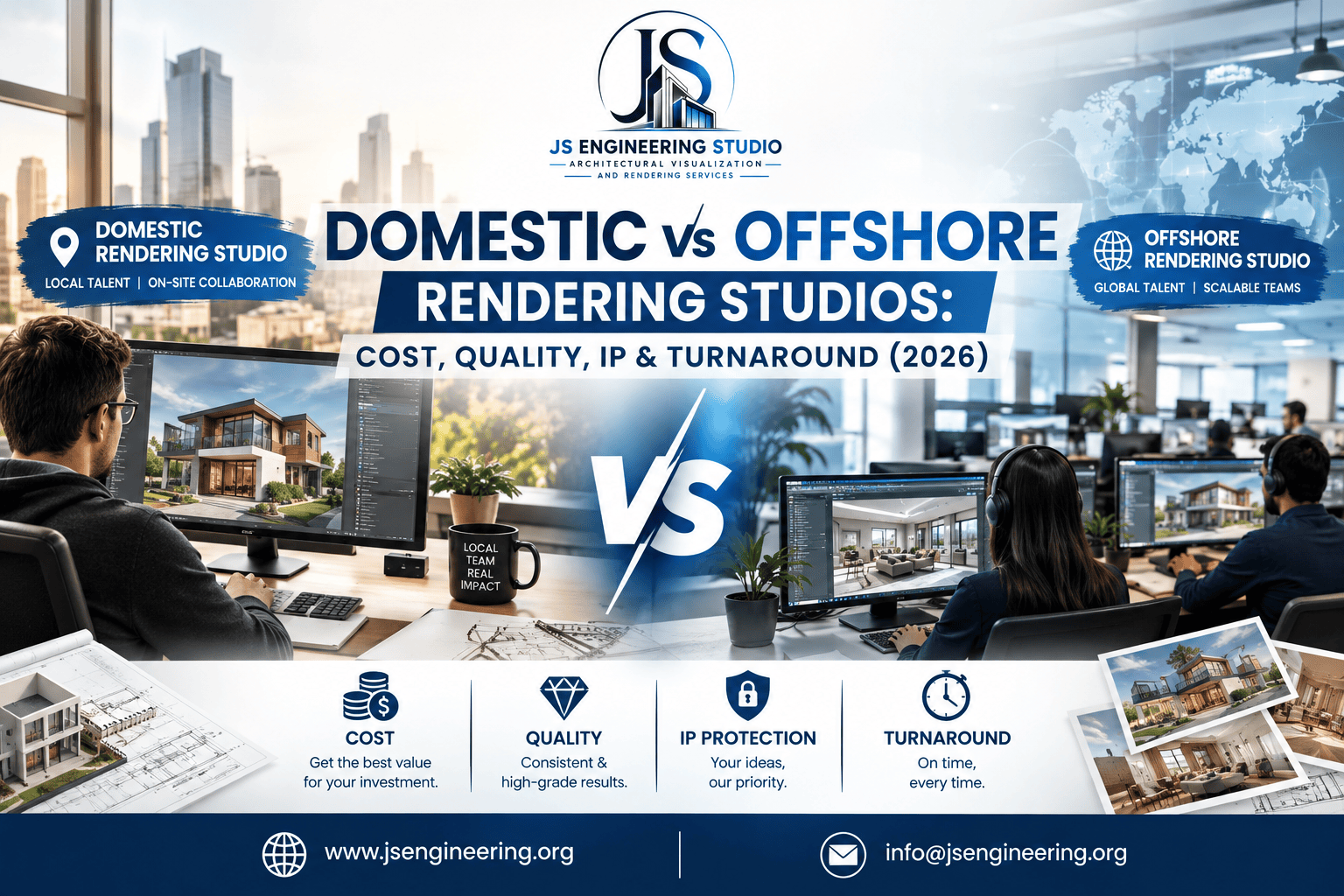
Choosing the right architectural visualization partner can make a significant difference in your project’s budget, presentation quality, and delivery schedule. For U.S. architects, builders and real estate developers, one important decision is whether to work with a domestic rendering studio or outsource the work to an offshore team.
Both options offer advantages. Domestic studios may provide easier communication and closer time-zone alignment, while offshore studios can offer competitive pricing, flexible production capacity, and access to specialized visualization talent.
In 2026, the best choice is not simply about finding the lowest price. It is about balancing cost, quality, intellectual property (IP) protection, and turnaround time. Understanding these factors helps you choose a rendering partner that fits your project requirements.
What Is the Difference Between Domestic and Offshore Rendering Studios?
A domestic 3D Rendering Studio operates in the same country as its client. For example, a U.S.-based architectural firm might hire an American 3D visualization company to create exterior renderings, interior perspectives, or real estate marketing animations.
An offshore rendering studio works from another country and delivers visualization services remotely. Many U.S. businesses outsource architectural rendering to international teams to manage production costs while maintaining professional presentation standards.
At JS Engineering Studio, we provide architectural visualization and rendering services for residential and commercial projects, helping clients turn architectural concepts into compelling visual presentations.
The right partner depends on your project’s complexity, required deliverables, communication preferences, and budget—not just the studio’s location.
1. Cost: Which Rendering Studio Offers Better Value?
Cost is often the first consideration when comparing domestic and offshore rendering studios. U.S.-based studios may have higher operating expenses, including salaries, office costs, and local business overhead. These expenses can influence the final price of architectural rendering services.
Offshore studios may operate with lower production costs, allowing them to offer competitive rates for 3D exterior rendering, 3D interior rendering, aerial visualization, and walkthrough animation.
However, a lower quote does not always mean better value. The total project cost can increase if the initial proposal excludes revisions, additional camera views, detailed landscaping, or animation changes.
Before selecting a studio, compare:
- The price per rendering or interior view.
- The number of revision rounds included.
- Modeling and material setup fees.
- Additional-view and animation charges.
- Project management and delivery costs.
Pro tip: Request a detailed quotation from every shortlisted studio. A transparent offshore partner can provide excellent value, while a domestic studio may be worth the premium when close collaboration is essential.
2. Quality: Does Location Affect Rendering Results?
High-quality architectural visualization depends primarily on artistic skill, technical expertise, project understanding, and quality control. A studio’s location alone does not determine the quality of its final images.
Domestic studios may offer an advantage when the team has extensive experience with local architectural styles, regional materials, building conventions, and market-specific presentation requirements.
Offshore studios can also produce photorealistic results when they have experienced artists, reliable workflows, and clear project documentation.
When evaluating portfolios, look for:
- Realistic lighting, shadows, and reflections.
- Accurate materials, textures, and finishes.
- Convincing landscaping and environmental details.
- Consistent quality across interior and exterior views.
- Strong camera composition and architectural accuracy.
At JS Engineering Studio, our architectural visualization services focus on presenting design intent through detailed 3D exterior rendering, 3D interior rendering, and architectural walkthrough animation.
For the fairest comparison, share the same drawings, references, and deliverables with each shortlisted studio. Compare the portfolios and proposed workflow before making a decision.
3. Intellectual Property (IP): Protecting Your Designs
Intellectual property protection is particularly important when working with unbuilt homes, commercial developments, confidential client projects, or designs that have not yet been publicly announced.
Before sharing architectural drawings, CAD files, BIM models, or project specifications, confirm how the studio handles confidential information and ownership rights.
Whether you choose a domestic or offshore rendering studio, discuss the following points in writing:
- Confidentiality: Sign a non-disclosure agreement (NDA) when required.
- Ownership: Clarify who owns the final images, custom models, and other project deliverables.
- Usage rights: Specify how the renders can be used for marketing, advertising, presentations, and publications.
- File security: Confirm how project files are stored, accessed, and shared.
- Third-party assets: Check the licensing terms for furniture models, textures, fonts, and other digital assets.
Working with a domestic studio may make certain legal and contractual matters easier to manage. Offshore partnerships can also be secure, but cross-border contracts require careful attention to applicable law, jurisdiction, and enforcement.
At JS Engineering Studio, we recommend establishing project scope, confidentiality expectations, and deliverable ownership before production begins. Clear agreements help both clients and visualization teams work with greater confidence.
4. Turnaround Time: Which Option Is Faster?
Delivery speed depends on project complexity, the number of views, the quality of the supplied drawings, and the studio’s production workflow.
Domestic studios may benefit from overlapping business hours, making it easier to discuss revisions, approve camera angles, and resolve questions quickly. Offshore teams may operate across different time zones, but this can also create opportunities for overnight progress when communication is organized effectively.
For example, a U.S. architect can send feedback at the end of the workday and potentially receive an updated draft the following morning. This depends on the agreed schedule and the studio’s availability.
To keep a project on track, establish:
- A clear production schedule with milestone dates.
- An initial preview or draft approval stage.
- A defined number of revision rounds.
- A named point of contact.
- A final delivery date with agreed file formats.
For architectural visualization projects, JS Engineering Studio recommends sharing complete drawings, material references, camera locations, and examples of the desired visual style at the beginning. A well-prepared brief reduces unnecessary revisions and helps the team work efficiently.
5. Domestic vs. Offshore Rendering Studios: Quick Comparison
Factor | Domestic studio | Offshore studio |
|---|---|---|
Cost | Often higher operating costs | Often more budget-friendly |
Visual quality | Depends on skills and workflow | Depends on skills and workflow |
Communication | Usually easier time-zone alignment | May require planned communication windows |
IP protection | Local contracts may be easier to enforce | Cross-border terms need careful review |
Production capacity | Depends on team size | Can offer flexible remote capacity |
Turnaround | Convenient for real-time discussions | Can benefit from time-zone differences |
Best suited for | Projects needing close collaboration | Projects prioritizing cost efficiency and scalable production |
These are general tendencies, not guarantees. Evaluate each studio individually and compare quotations with equivalent deliverables, revision allowances, and deadlines.
6. How to Choose the Right Rendering Partner in 2026
The best rendering studio is one that understands your project, respects your budget, and delivers consistent results.
Before hiring, review its portfolio, request a sample relevant to your project type, and ask about its production and approval process. Confirm that the team can handle the required number of images, architectural details, and delivery formats.
For U.S. architects, builders, and real estate developers, offshore architectural visualization can be a practical option for managing costs without compromising presentation standards. Domestic studios remain valuable when frequent collaboration, local familiarity, or in-person coordination is essential.
A hybrid approach can also work well: use an offshore team for repeatable production work and a domestic partner for projects that require close creative direction or local coordination.
JS Engineering Studio provides architectural visualization and rendering services for residential and commercial projects, including 3D exterior rendering, 3D interior rendering, real estate visualization, and walkthrough animation.
Our goal is to help architects, builders, and developers present their designs clearly through compelling visual content.
Frequently Asked Questions (FAQs):
1. Are offshore rendering studios cheaper than domestic studios?
Offshore rendering studios often have lower operating costs and can offer competitive pricing. However, the final cost depends on project complexity, image quality, modeling requirements, revisions, and delivery schedules.
2. Is the quality of offshore architectural rendering as good as domestic rendering?
Yes, it can be. Quality depends on the artists’ expertise, lighting, materials, modeling accuracy, art direction, and quality-control process rather than location alone. Always review relevant portfolio examples before hiring.
3. How can I protect my architectural designs when outsourcing rendering?
Use an appropriate NDA, establish ownership and usage rights in the contract, and agree on secure file-sharing practices. For sensitive projects, seek legal advice about cross-border enforceability and applicable law.
4. Does offshore rendering take longer to complete?
Not necessarily. Offshore studios can deliver efficiently when project requirements and feedback are clear. However, time-zone differences may slow down revisions if there are no agreed communication windows.
5. What should I provide to a rendering studio for an accurate quote?
Provide available architectural drawings, CAD or BIM files, a 3D model if available, material references, desired camera views, image resolution, project requirements, and your deadline. These details help the studio estimate the cost and schedule accurately.
6. Why choose JS Engineering Studio for architectural visualization?
JS Engineering Studio offers 3D exterior rendering, 3D interior rendering, and architectural walkthrough animation for residential and commercial projects. We focus on clear communication, realistic visual presentation, and project-specific solutions for architects, builders, and developers.
Conclusion:
Choosing between domestic and offshore rendering studios in 2026 comes down to understanding what matters most for your project. Cost, image quality, intellectual property protection, and turnaround time should all be considered before making a decision.
A domestic studio may offer convenient collaboration, while an offshore studio can provide cost-effective production and flexible capacity. The right choice is the partner that meets your quality expectations, protects your project information, communicates clearly, and delivers within the agreed schedule.
Looking for a reliable architectural visualization partner for your next project? JS Engineering Studio can help transform architectural plans into engaging visual presentations for residential and commercial developments.
📩 Request a project quote: Share your drawings, reference images, required views, and deadline.